India Emerges as a Global Leader in Machine Learning-Enabled Scientific Research, New Report Finds
Dec 12, 2025
PNN
New Delhi [India], December 12: India has emerged as one of the world's most dynamic and rapidly advancing centers for machine learning (ML)-enabled scientific research, according to the newly released ML Global Impact Report 2025 by Marktechpost. New dataset shows India rapidly strengthening its position in global AI-driven science, ranking third worldwide for ML-enabled research published across the Nature family of journals.
The study, covering more than 5,000 ML-relevant scientific articles published in the Nature family of journals between January 1 and September 30, 2025, identifies India as the third-largest contributor to ML-supported scientific output worldwide -- behind only China and the United States.
India's rise reflects an expanding network of universities, medical institutions, national laboratories, deep-tech startups, and AI research centres that are applying ML to address the country's most complex scientific and societal challenges. ML has become a foundational tool in India's scientific ecosystem, powering innovation across domains essential to national development.
India's Rapid Growth in ML-Driven Scientific Research
Indian researchers demonstrated extensive adoption of widely used ML frameworks -- including XGBoost, Transformers, ResNet, U-Net, YOLO, LightGBM, and CatBoost -- applying them across high-impact scientific fields such as:
* medical imaging, diagnostics, cancer screening, and genomics
* climate science, monsoon prediction, and environmental modeling
* agriculture, crop-yield forecasting, and food systems resilience
* materials science, chemistry, and nanotechnology
* Earth-observation, remote sensing, and disaster preparedness
This broad range of applications highlights India's focus on practical, scalable, and socially relevant ML research, with a strong orientation toward national priorities in health, agriculture, climate resilience, and sustainable development.
Research Volume vs. Density: India's Expanding Scientific Footprint
The report shows that while China leads in research volume and the United States in disciplinary breadth, India is experiencing a steep upward trajectory in ML-driven science -- with more institutions participating each year.
India's expansion is supported by:
* growing interdisciplinary research clusters
* increased investment in AI for health, agriculture, and climate
* strong contributions from both Tier 1 and Tier 2 universities
* a rapidly growing startup ecosystem translating research into applied innovation
India's participation is increasingly distributed and collaborative, positioning it as one of the fastest-growing ML-enabled scientific ecosystems in the world.
Collaboration: India's Strength in Scientific Partnerships
Like global ML research, India's scientific output is highly collaborative, with most ML-enabled studies involving 2-15 institutional affiliations. Indian collaborations frequently connect:
* academia and medical institutions
* computational labs and engineering departments
* public research organizations and industry partners
* deep-tech startups and clinical institutions
International collaboration is an especially important factor, with India appearing prominently in partnerships with:
* the United States, especially in health, genomics, and climate
* Saudi Arabia, particularly in materials science and applied ML
* global research networks working in computer vision, environmental science, and agriculture
These collaboration patterns demonstrate India's growing integration into the global ML research community.
Beyond Generative AI: Classical ML Powers India's Scientific Impact
Despite the popularity of generative AI models, the report finds that India's scientific progress is driven primarily by mature, proven machine learning techniques, mirroring global trends. Classical ML methods -- including Random Forest, SVMs, and Scikit-learn-based workflows -- account for 47% of all ML use cases worldwide, and these approaches remain central to India's research output.
When combined with established ensemble approaches such as GBM, XGBoost, LightGBM, and CatBoost, these traditional methods represent over 75% of the ML techniques powering real scientific work. This reinforces India's focus on practical, scalable innovation, rather than hype-driven experimentation.
India's research environment uses ML primarily for application-oriented scientific tasks, including prediction, early diagnostics, environmental modeling, and agricultural optimization -- areas where classical and ensemble ML methods deliver immediate, real-world impact.
India in Global Context: A Top-Three Scientific Power
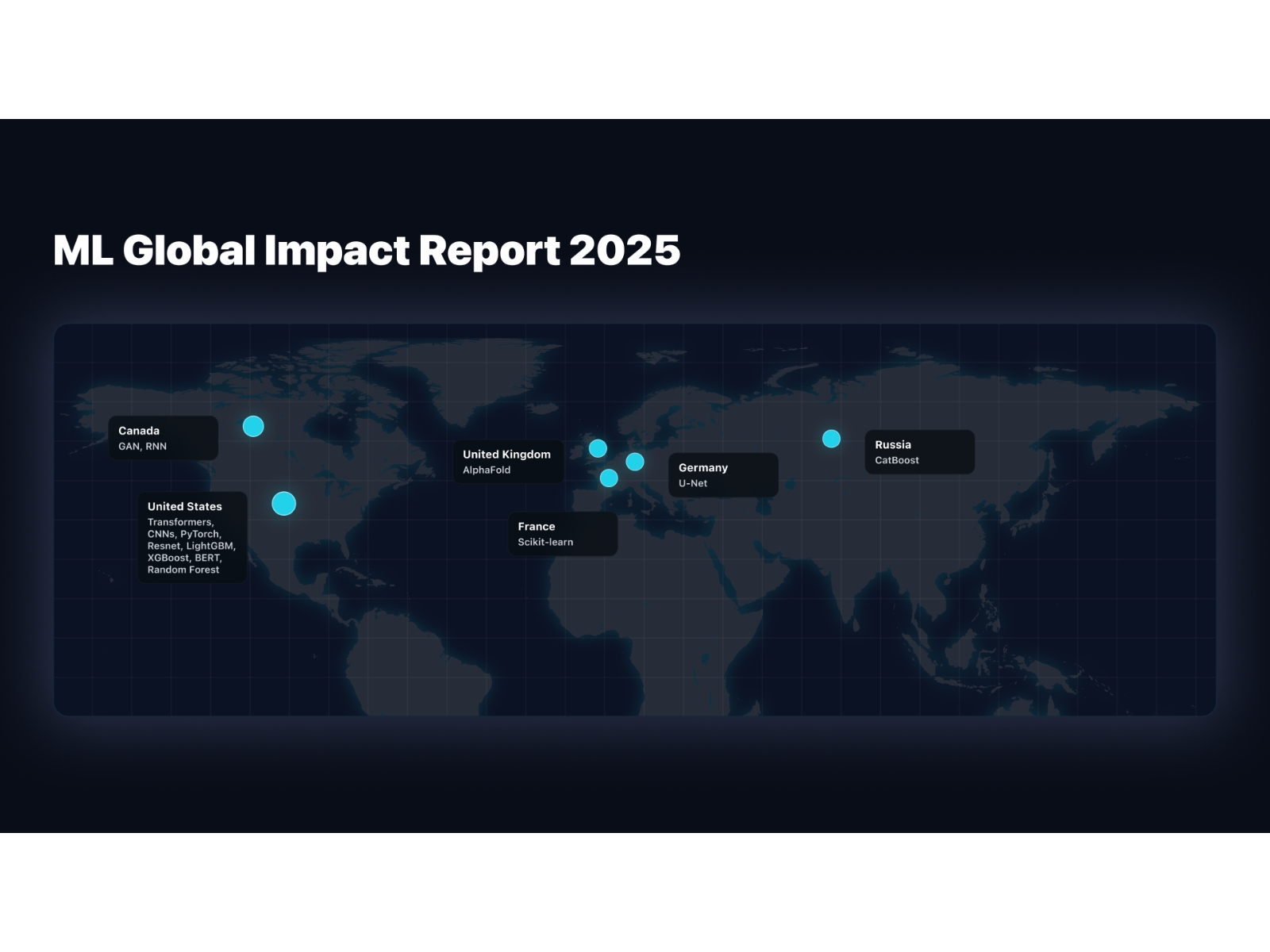
India's third-place ranking highlights the country's rising influence in global ML-driven science. The report situates India within a broader ecosystem shaped by foundational ML tools originating from:
* United States (core ML infrastructure)
* Canada (GAN)
* United Kingdom (AlphaFold)
* Germany (U-Net)
* France/EU (Scikit-learn)
* Russia (CatBoost)
India's expanding research output shows how the country is actively contributing to -- and benefiting from -- the global ML innovation landscape.
Industry Commentary
Dr. Geetha Manjunath, Founder, CEO & CTO, NIRAMAI Health Analytix
"India's surge in machine learning-driven scientific research -- particularly in medical imaging, diagnostics, and genomics -- is shaping a future where advanced technologies translate into improved population health at scale."
NIRAMAI's Thermalytix® platform is a leading example of India's ability to convert ML-supported scientific research into clinically validated, affordable, and globally scalable healthcare innovation. The technology enables early detection of breast cancer without radiation, compression, or on-site radiologists, making it suitable for population-scale screening -- especially in low-resource settings.
"Solutions like Thermalytix® demonstrate how India's innovation ecosystem is using ML to develop equitable health technologies that create real impact for millions," she added.
Asif Razzaq, Editor & Co-Founder, Marktechpost
"India's rise in ML-powered scientific research is one of the most notable trends in this dataset. What stands out is the country's ability to apply machine learning across diverse scientific domains -- from agriculture and health to climate and engineering. India has firmly established itself as a key contributor to the global ML research ecosystem."
Methodology
The analysis examined all ML-relevant scientific articles across the Nature portfolio from January 1 to September 30, 2025. A unified Python-based pipeline identified ML-flagged articles and extracted:
* scientific field
* author-country affiliation
* ML tools used
* the scientific contribution enabled by ML
* citation information (where available)
Tools frequently used in India's research ecosystem included Transformers, XGBoost, ResNet, U-Net, YOLO, LightGBM, CatBoost, and BERT -- demonstrating India's broad and maturing integration of ML across its scientific landscape.
About Marktechpost
Marktechpost is a global publication covering artificial intelligence, machine learning, and emerging technology research. The platform highlights advances from academic institutions, research labs, and practitioners shaping the future of applied AI. https://www.marktechpost.com/
(ADVERTORIAL DISCLAIMER: The above press release has been provided by PNN. ANI will not be responsible in any way for the content of the same.)