The Next Promotion in Operations May Depend Less on Experience and More on AI
Aug 18, 2026
VMPL
New Delhi [India], August 18: Professionals who can combine operational expertise with AI capabilities are increasingly commanding a premium in today's job market. According to PwC's 2025 Global AI Jobs Barometer, workers with AI skills earn an average 56% wage premium over peers in comparable roles, while industries adopting AI are seeing three times higher growth in revenue per employee than less AI-exposed sectors. The research also found that the skills required for AI-exposed jobs are evolving 66% faster, signalling a rapid shift in what employers value.
For operations and supply chain professionals, the message is becoming difficult to ignore. Traditional expertise in procurement, inventory management, production planning, and logistics remains essential, but organisations are increasingly rewarding leaders who can apply AI, analytics, and predictive technologies to improve decision-making and build resilient supply chains.
Artificial intelligence is already transforming how global businesses operate. Demand forecasting is becoming more accurate through machine learning. Predictive analytics is helping organisations anticipate supply chain disruptions before they occur. Digital twins are enabling manufacturers to simulate production scenarios, while autonomous planning systems are reshaping inventory, procurement, and distribution decisions.
In this new environment, operational excellence is no longer defined solely by efficiency. Increasingly, it is defined by intelligence--the ability to combine operational expertise with data, analytics, and AI to make faster, smarter, and more strategic decisions.
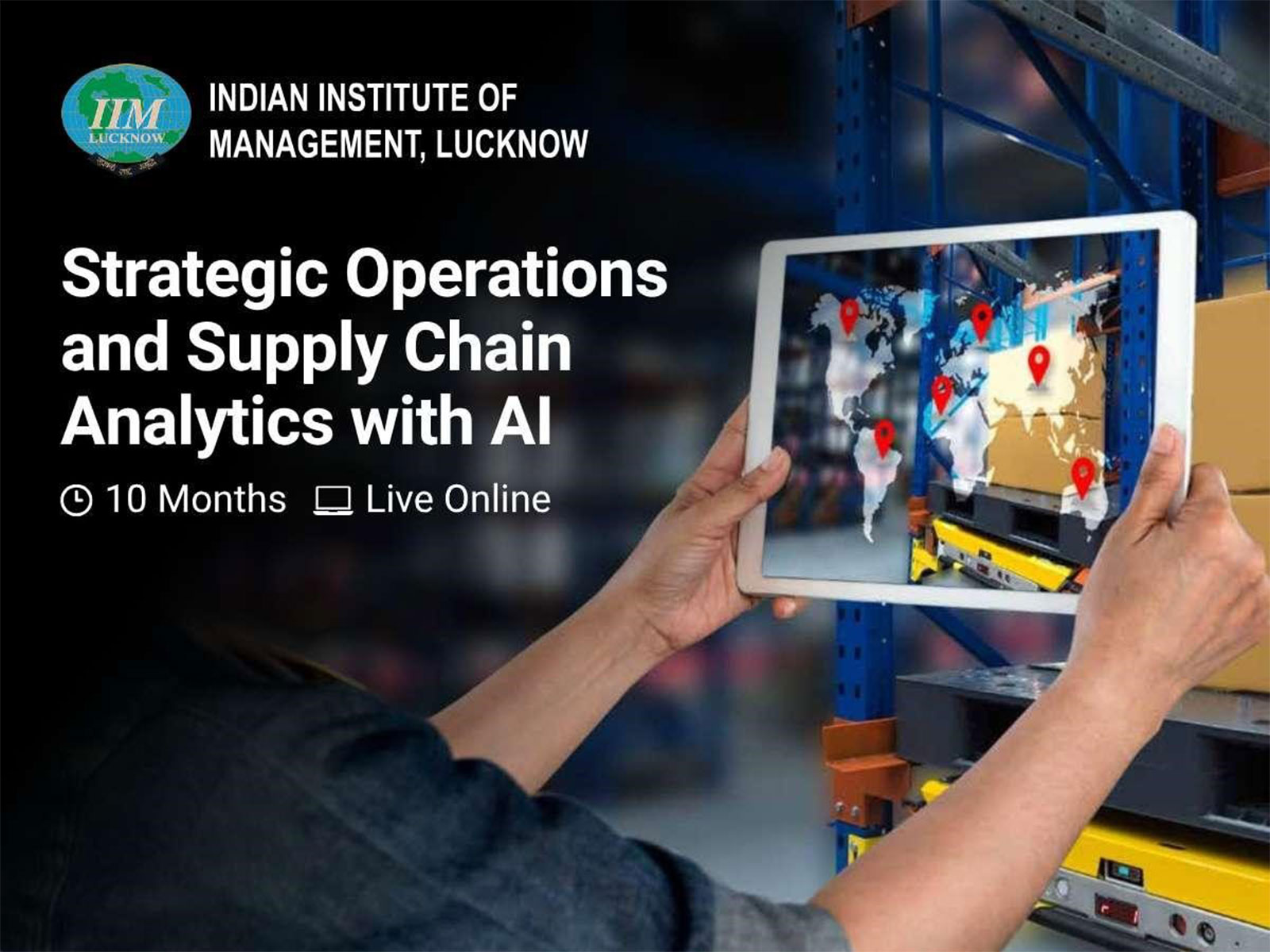
Recognising this evolution, IIM Lucknow has introduced the Strategic Operations and Supply Chain Analytics with AI programme, a 10-month executive programme designed to help working professionals build capabilities at the intersection of operations management, supply chain strategy, analytics, and artificial intelligence.
Rather than treating AI as a standalone technology topic, the programme positions it as a practical management capability. Participants explore how analytics, predictive modelling, Agentic AI, and digital technologies can strengthen operational decision-making, improve supply chain visibility, and create more resilient business systems. The curriculum also examines supply chain digital transformation, analytical tools and techniques, and retail and e-commerce operations, reflecting the realities of today's interconnected business environment.
Perhaps the most significant aspect of the programme is its emphasis on application over theory.
Operations leaders rarely solve textbook problems. They manage supplier uncertainty, fluctuating demand, inventory volatility, production bottlenecks, transportation disruptions, and evolving customer expectations--often simultaneously. Reflecting this reality, the programme integrates industry case studies throughout the learning journey, allowing participants to analyse real operational challenges faced by organisations and evaluate how data-driven decision-making influences business outcomes. Learning culminates in a faculty-guided capstone project that enables participants to apply concepts to a real business problem.
The programme also acknowledges an important truth about executive education: most professionals cannot step away from work to learn.
Delivered through live online sessions by IIM Lucknow faculty over ten months, the programme enables participants to continue leading teams and managing operations while immediately applying classroom insights within their organisations. A campus immersion further complements the online learning experience by providing opportunities for deeper faculty interaction and peer networking.
Equally valuable is the diversity of the participant cohort. Professionals from manufacturing, logistics, retail, e-commerce, consulting, and other sectors contribute different operational perspectives, creating discussions that mirror the complexity of modern supply chains. As organisations increasingly collaborate across ecosystems rather than operate in isolation, exposure to diverse approaches has become an important part of management learning.
This broader perspective reflects a larger transformation taking place across global operations.
Supply chains are no longer viewed as back-office functions focused solely on cost control. They have become strategic assets capable of influencing customer experience, business resilience, sustainability, and competitive differentiation. Recent global disruptions have reinforced the importance of building networks that are not only efficient but also agile, predictive, and technology enabled.
That evolution is also changing leadership expectations.
Operations managers are increasingly expected to interpret data, evaluate AI-driven recommendations, lead digital transformation initiatives, and make faster, more informed decisions in environments where uncertainty has become the norm. The professionals who thrive will be those who can bridge traditional operational expertise with emerging technologies rather than treating them as separate disciplines.
As AI continues to redefine how goods are produced, moved, and delivered, the future of operations will belong not simply to those who understand supply chains, but to those who understand how technology can make them smarter, faster, and more resilient.
In the years ahead, operational excellence may no longer be measured solely by efficiency. It may well be defined by intelligence.
(ADVERTORIAL DISCLAIMER: The above press release has been provided by VMPL. ANI will not be responsible in any way for the content of the same.)