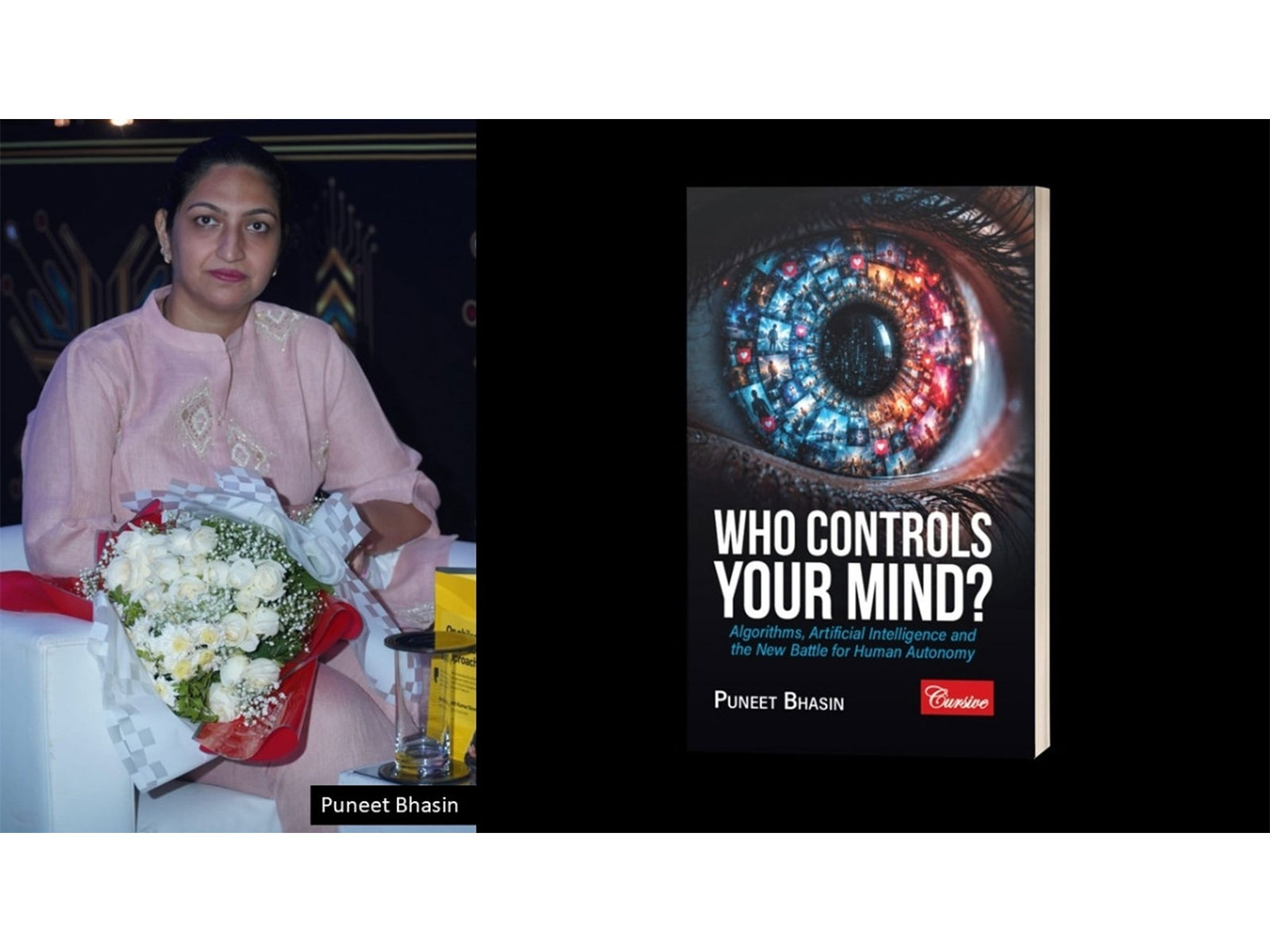
Cyber Law Expert Puneet Bhasin’s New Book Explores Who Really Controls Human Choices in the Age of AI
Nov 03, 2026
PNN
Mumbai (Maharashtra) [India], November 3: Are the thoughts, choices and decisions people make truly their own, or are algorithms, artificial intelligence and digital platforms quietly influencing them? This question lies at the heart of cyber law expert and advocate Puneet Bhasin’s new book, Who Controls Your Mind? Algorithms, Artificial Intelligence and the New Battle for Human Autonomy, published by Cursive, an imprint of OakBridge Publishing.
The book examines the growing influence of algorithms, artificial intelligence and data-driven platforms on human attention, behaviour and decision-making, while exploring whether existing laws are equipped to protect individual autonomy in an increasingly digital world.
The idea for the book emerged from an interaction Bhasin had with a group of 17- and 18-year-old students. When she asked how many planned to marry or have children, only two students raised their hands in response to each question. The students came from otherwise stable backgrounds, but some acknowledged regularly watching social media content that mocked marriage and family life.
The interaction prompted Bhasin to examine a larger question: how much of what people believe is their own choice may be shaped by the digital environments they inhabit.
Bhasin argues that digital platforms have evolved beyond simply collecting personal information. Every search, pause, click and interaction generates data, which is used to build behavioural profiles and predict what users are likely to engage with next. She describes this process as “Data Farming”, suggesting that platforms not only collect behavioural data but also cultivate the behaviour that generates it.
The book uses the fictional story of a teenager, Veer, and his family to explain complex technological and legal issues through everyday situations. These include excessive gaming, data breaches, AI-generated voice scams, online spiritual influencers, AI companions and other forms of digital dependence.
Spread across 18 chapters and five parts, the book examines the functioning of algorithms and their impact on human behaviour before turning to the legal and policy questions surrounding digital influence.
It explores subjects including short-form video and attention, artificial intelligence and memory, digital detox, data breaches, AI voice scams, harassment in virtual environments, the portrayal of crime on streaming platforms, online risks to children, algorithmic influence on faith, educational technology, gaming design, AI chatbots and the use of digital influence in modern warfare.
The legal analysis draws on Indian legislation and judicial decisions, including the Digital Personal Data Protection Act, 2023, the Information Technology Act, 2000, its 2026 amendment rules, the Bharatiya Nyaya Sanhita and the Supreme Court's landmark judgments in K.S. Puttaswamy and Selvi. The book also examines international developments and legal approaches in Australia, Europe, the United Kingdom and the United States.
One of the book's key contributions is its proposal of new legal concepts, including “Cognitive Sovereignty”, which Bhasin describes as an individual's right to remain in control of their attention, thoughts and decisions.
Another concept, “Cognitive Habeas Corpus”, raises the question of whether the constitutional protection of privacy and dignity under Article 21 could be extended to protect individuals from forms of technological influence that may interfere with mental autonomy.
The book also introduces the idea of “Cognitive Injury by Design”, questioning whether companies that intentionally design products to create behavioural dependence should bear responsibility for the resulting harm.
Bhasin further examines the applicability of the “safe harbour” protection available to intermediaries under Section 79 of the Information Technology Act. She questions whether platforms that actively determine and amplify the content consumed by millions of users can continue to be treated simply as neutral intermediaries.
However, the book does not position technology as an inherent threat. Instead, it advocates greater awareness and individual agency while recognising the benefits of technological innovation.
Its concluding chapters offer practical approaches to maintaining digital autonomy, including questioning the source of one's thoughts, treating attention as a finite resource, actively searching for information instead of passively consuming feeds and creating small barriers against compulsive digital consumption.
“The practice of sovereign thought begins with a pause,” Bhasin writes.
The book carries forewords from former Bombay High Court judge Justice Vidyasagar M Kanade, Former Lokayukta of Maharashtra and Acting Chief Justice of Bombay High Court and former Intelligence Bureau Director Rajiv Jain, Tamil Nadu Director General of Police Dr Sandeep Mittal and Sumnesh Joshi, Deputy Director General, Ministry of communications. Colonel Ashish Upreti, VSM, Director Social Media, Additional Directorate General of Strategic Communication, Indian Army, has written the afterword.
Justice Kanade notes that it will ultimately be for scholars and courts to determine whether concepts such as cognitive sovereignty develop into independent legal rights or serve as guiding principles for future legislation. Dr Mittal, while cautioning against treating every recommendation system as inherently manipulative, observes that questions around technology, influence and autonomy are no longer merely academic.
Bhasin said the book is intended for a wide readership, including parents trying to understand their children's digital environments, students and young professionals navigating algorithm-driven platforms, and lawyers, policymakers and law-enforcement professionals examining the limitations of existing legal frameworks.
The book ultimately returns to its central question — who controls the human mind in an age where technology can increasingly predict, influence and shape behaviour?
“The answer, in the end, is up to you,” Bhasin writes.
About Puneet Bhasin
Puneet Bhasin is an Internationally renowned advocate and cyber law expert working at the intersection of law, cybersecurity and technology. She advises institutions and companies and represents victims of cyber offences and has advised the United Nations Digital Public Goods Alliance for the drafting of the DPG Privacy Framework. Her earlier works are Practical Guide to Digital Personal Data Protection Act, 2023: Law and Compliance, Digital India, Regulated India and Laws Governing Social Media & OTT in India.
Book: Who Controls Your Mind? Algorithms, Artificial Intelligence and the New Battle for Human Autonomy
Publisher: Cursive, an imprint of OakBridge Publishing
Author: Puneet Bhasin
(ADVERTORIAL DISCLAIMER: The above press release has been provided by PNN. ANI will not be responsible in any way for the content of the same.)